Leading Laundry Solutions for Your Healthcare Facility Needs

Keep your staff and residents clean and healthy with durable, high-quality commercial laundry equipment. UniMac®, Speed Queen® and Huebsch® washers and dryers are specially designed to handle the relentless pace that long-term care facilities and assisted living centers see every day. Lighten the load with tools and resources that make maintaining healthcare compliance standards—and delivering the comfort and care your facility’s residents deserve—so much easier.

  • speed queen washer

Nonstop Laundry Requires Unstoppable Machines

UniMac, Speed Queen and Huebsch commercial washers and dryers keep stride with around-the-clock healthcare laundry demands. Fewer repairs and less downtime mean your laundry machines are ready whenever you need them.

Contact Us

Questions about your laundry equipment? Want to connect with experts about financing or your next steps? Fill out the form below to learn more about our washers, dryers, parts, service, and financing options.

Improve Employee Efficiency with Smart Laundry Equipment

Streamline your healthcare facility’s new hire training with advanced technology. Improved labor efficiency is good news for your employees—and your bottom line.

Supporting the Highest Standard of Clean, No Matter Your Facility’s Needs

Healthcare laundry requires washing and drying equipment that can perform consistently, 24/7. UniMac, Speed Queen and Huebsch machines last load after load to give your staff and residents:

A Better Investment for Your Healthcare Laundry Needs

Adding UniMac, Speed Queen and Huebsch washers and dryers to your long-term care facility’s laundry room gives you so much more than reliable laundry solutions. Investing in exceptional laundry equipment ensures your healthcare facility benefits from:

Machine Lineup

Find Your Trusted Partner for Commercial Laundry Equipment

Alliance Laundry Systems Distribution is your full-service laundry partner with 150+ years of industry expertise. We’re with you from design to installation to maintenance, with local teams who know what you need. Get the peace of mind that comes with knowing your facility’s laundry is thoroughly clean.
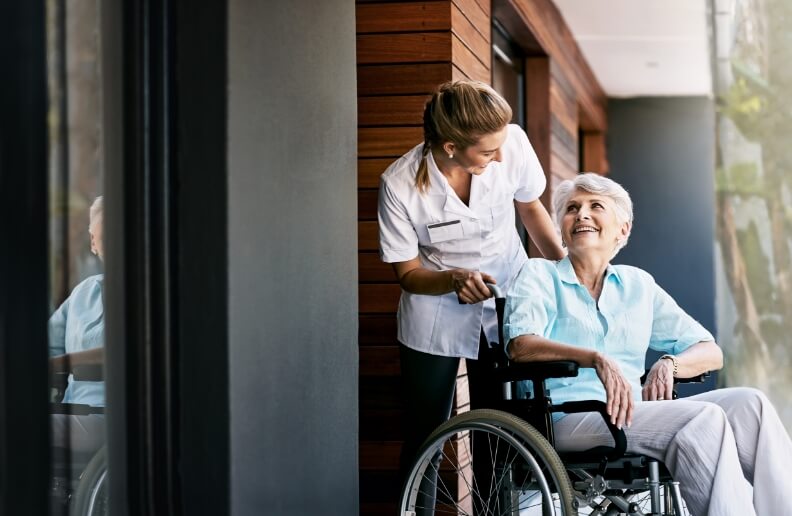
Caregiver assisting a smiling senior resident in a wheelchair

Your Healthcare Laundry Questions, Answered.

What long-term care and assisted-living operators ask us most about identifying, financing and servicing commercial laundry equipment.

Still Have Questions?

Your local Alliance Laundry Systems Distribution team can size a laundry room, quote financing, schedule service and answer any other questions you have.

It depends on your resident count, laundry volume and whether linens need a dedicated disinfection cycle. Most long-term care facilities land on a mid- to large-capacity commercial or industrial washer with programmable cycles, since that gives control over water temperature and water levels for infection control.

Rinsing technology that flushes wash chemistry and residue down the drain, rather than letting it recirculate, is also worth asking about. This can help your facility’s linens come out with less leftover residue. OPTispray™ technology from UniMac® is built around this. UniMac® reports that OPTispray leaves 22% less residual wash chemistry in the load. Speed Queen® and Huebsch® OPL equipment offer programmable cycles and water levels, so more water can be programmed for thorough rinsing.

Connected systems, like CORE technology from UniMac, can log cycle data, including temperatures and run times, which gives facilities a record to reference if a surveyor asks how disinfection benchmarks are being met. Documentation capabilities vary by model, so ask your distributor whether CORE is available on the equipment they carry.

Start with four things:

  1. Programmable cycles for consistent disinfection temperatures
  2. Easy-to-use controls that help staff run the right cycle every time
  3. A service network that keeps equipment running with minimal downtime
  4. Connected monitoring technology that lets staff track cycle status and get maintenance alerts remotely

Reliable turnaround matters more than extra features, especially in a commercial laundry room running multiple loads a day. Connected CORE technology by UniMac can be especially useful for facilities running lean on laundry staff, since it cuts down on physically checking machines throughout the day. Ask your team whether CORE is available on the equipment they carry.

A local distributor can walk through these considerations based on your facility’s resident population and space.

A few things drive the number: equipment investment, labor, linen replacement and chemicals. UniMac equipment is designed with a low total cost of ownership in mind, so the purchase price is only part of the picture.

If you’re running multiple loads a day, your facility may also benefit from equipment built for continuous heavy use, since it aims to limit the repair costs and downtime that can interrupt resident care. Lint-reduction technology can help control those costs: UniMac, Speed Queen and Huebsch all offer a version of ProCapture™, designed to trap lint at the source before it builds up in ductwork, cutting down on manual cleaning time and maintenance calls tied to clogged vents.

The right choice depends on resident count, laundry volume and whether the facility has room and staff for an on-site laundry operation. Handling laundry in-house with commercial laundry equipment gives a facility more direct control over infection control protocols and wash temperatures instead of relying on a third-party provider’s process. Outsourcing to a third-party linen service can lower staffing and equipment costs upfront but adds ongoing per-pound service fees and less direct oversight of disinfection standards.

CDC guidance for healthcare laundering points to hot water at 160°F for at least 25 minutes as a commonly recommended benchmark for killing bacteria and other pathogens during a wash cycle. As a separate option, CDC guidance notes that low-temperature washing at 71°F to 77°F can also reduce microbial contamination, as long as the washer cycle, detergent and bleach are carefully controlled. Chlorine bleach can also be added during hot-water cycles as an extra margin of safety, and it becomes activated once water reaches 135°F to 145°F.

Hitting these benchmarks consistently also depends on staff selecting and running the correct cycle every time. UniLinc™ Touch from UniMac is designed to simplify that cycle selection so the right temperature and time run reliably regardless of who’s operating the machine. Speed Queen and Huebsch OPL equipment offer programmable cycles for water level and temperature, though how much can be programmed varies by control type.

Source: CDC, Guidelines for Environmental Infection Control in Health-Care Facilities: Laundry and Bedding.

How often linens are changed depends on resident needs, and higher acuity residents or visibly soiled linens call for more frequent changes. Government regulations require facilities to handle, store, process and transport linens in a way that prevents the spread of infection, but the rule doesn’t set one fixed washing frequency. States often fill in that gap with their own licensing requirements, so the exact schedule can vary depending on where a facility is located.

Source: 42 CFR §483.80(e), Linens (Code of Federal Regulations).

Start with a conversation. A local Alliance Laundry Systems Distribution rep will want to know your resident count, current laundry setup and laundry needs. From there, they can help size the right commercial laundry facility setup and walk you through installation requirements and expectations, financing options and service and support.

Washing gets linens visibly clean, but it doesn’t necessarily kill the bacteria and pathogens that can linger on them. Disinfecting requires holding linens at a specific water temperature for a set amount of time, either through a hot-water cycle or a carefully controlled lower-temperature cycle that relies on bleach and the right detergent, rather than just running a normal wash. See the temperature question above for the specific benchmarks CDC describes for each method.

Source: CDC, Guidelines for Environmental Infection Control in Health-Care Facilities: Laundry and Bedding.

Long-term care laundry involves stricter infection control requirements than typical household or workplace laundry, since linens and personal clothing can carry bacteria and other pathogens between residents.

Facilities generally need programmable commercial washers that can hold a specific water temperature for a set cycle time to meet disinfection benchmarks rather than just getting linens visibly clean. CDC guidance also calls for keeping soiled and clean linens separate during handling and transport to prevent cross-contamination.

Sources: CDC, Guidelines for Environmental Infection Control in Health-Care Facilities: Laundry and Bedding; 42 CFR §483.80(e), Linens.

Yes, financing options are available as an alternative to an outright purchase, which can lower the upfront cost of outfitting a laundry room. Financing can also make it easier to upgrade equipment on a set schedule instead of running older machines until they fail. See current on-premises financing programs on the Alliance Laundry Systems finance page.

Yes, newer commercial washers and dryers generally use less water and energy per cycle than older equipment, which can lower utility costs in a facility that runs multiple loads a day. Many states also offer utility rebate or grant programs, so ask your local distributor what may be available in your area.

Drying control technology adds another layer of savings: OPTidry technology by UniMac is designed to stop a drying cycle at the ideal dryness level instead of running for a fixed amount of time, which cuts wasted energy and also helps protect linens from the fiber breakdown that over-drying causes.

Facilities with frequent staff turnover benefit from equipment that doesn’t require specialized training to operate correctly. UniLinc™ Touch from UniMac simplifies cycle selection, and using the same control interface across UniMac washers and dryers may also help shorten the learning curve for new hires even further.